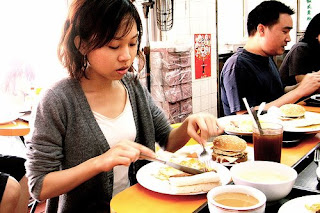
Real English Grammatical Clips from South Beach, Miami
This topical clip is for Intermediate students.
Real English 55 - Women
by realdogswimming
|
CONVERSATION PRACTICE
Real Life
Intro
It’s all over the news in the US. But Americans don’t need the news to tell them that gas is more expensive than it ever has been. They can see it at every fuel station.But what Americans haven’t seen yet is fewer cars on the road. It will take time for people to adjust to the high price of gas (although fuel in Europe is still more expensive than it is in the US) and for cities to provide more public transportation. At the moment, people are feeling the increased costs, and everyone’s talking about it.
Jason: If I see one more headline with the phrase “at the pump” in it, I’m going to shoot somebody.
Beren: “At the pump”? Like, “Prices at the Pump…
Jason: “Prices at the Pump”
Beren: ...Blowing up”
Jason: “Pinched at the Pump.”
Beren: “Pinched at the Pump.” What’s another one?
Jason: It’s like, yeah, gas is expensive, I know. I’ve been buying gas, I can see that it’s expensive.
Beren: What’s kind of mind boggling though is that gas is so expensive but it doesn’t seem to be…at least here, it doesn’t seem to be affecting who’s driving. I see just as many cars now as I did before.
Jason: Back when it was half as much a few years ago, you’d see just the same amount of cars.
Beren: Yeah, it’s weird. Especially since you’d think people would be like, “Oh, this is perfect opportunity to start biking or using public transportation.” Because it’s so expensive. I put $10 in my car which usually, like before this, used to get a quarter of a tank. Like, I’d drive to work and home or whatever. And now it lasts me a day, if that, if I’m driving. $10!
Jason: And like…what is it going to take? Like how expensive is it going to have to get for driving to taper off a little bit?
Beren: I don’t know. Like I feel like the people that drive a lot probably can’t afford to in a sense so maybe they’re cutting out other things. Like, “I want to drive so I guess we won’t eat out as much.” I don’t know. It’s weird.
Jason: A lot of people don’t have a choice. We really kind of messed up here because we built an infrastructure that pretty much makes it impossible to not drive in a lot of cities.
Beren: Yeah.
Discussion
Jason says that he’s tired of reading news about gas prices. He says he’s aware of how expensive it is because he has to pay for it all the time.Beren is surprised that she doesn’t see fewer cars. She spends as much as $10 a day on gas right now and wonders how many people can afford to drive at all.But do they have a choice? Jason thinks it’s a shame that US has built its entire transpiration system around cars, so much so that there aren’t other options for getting to certain places.Has the cost of fuel gone up where you live? What’s the main form of transport you use? Why?
Grammar Point
Beren says she “put $10 in her car.” That means she put $10 worth of fuel in the tank.
mind boggling adj.
*difficult to comprehend; hard to imagine but true
Example:The size of their company is mind boggling. They have thousands of employees in hundreds of offices.
infrastructure n.
*the facilities and services that serve a country
Example:A country's infrastructure is often much improved a few decades after it's destroyed by a war.
pinch v.
*to burden a budget
Example:Ever since the family sent their son to college, their cash flow has been a little pinched.
blowing up expr.
*increasing quickly
Example:The city has been blowing up for a few years now. It's population is twice what it was a few years ago.
feeling v.
*experiencing something difficult
Example:We've really been feeling the budget cuts in our department. It's been hard to get anything done.
all over expr.
*everywhere, in many places
Example:There are McDonald's restaurants all over the U.S.
cut out v.
*get rid of; stop spending money
Example:We need to cut out some of our expenses so we can hire a new employee.
taper off v.
*decrease slowly; lessen over time
Example:CD sales started to taper off when Mp3s became popular.
if that expr.
*if even that much; or perhaps even less
Example:Oh I only exercise twice a week if that.
public transportation system n.
*buses, subways, trolleys, trams
Example:The public transportation system in Washington D.C. is really great! You can get anywhere you need to go using the Metro or the busses.
|
Useful Meeting Phrases
Interrupting
May I have a word?
If I may, I think...
Excuse me for interrupting.
May I come in here?
Giving Opinions
I (really) feel that...
In my opinion...
The way I see things...
If you ask me,... I tend to think that...
Asking for Opinions
Do you (really) think that...
(name of participant) can we get your input?
How do you feel about...?
Commenting on Other Opinions
I never thought about it that way before.
Good point!
I get your point.
I see what you mean.
Agreeing with Other Opinions
Exactly!
That's (exactly) the way I feel.
I have to agree with (name of participant).
Disagreeing with Other Opinions
Up to a point I agree with you, but...
(I'm afraid) I can't agree
Advising and Suggesting
We should...
Why don't you....
How/What about...
I suggest/recommend that...
Asking for Repetition
I didn't catch that. Could you repeat that, please?
I missed that. Could you say it again, please?
Could you run that by me one more time
Asking for Clarification
I'm afraid I don't quite understand what your are getting at.
Could you explain to me how that is going to work?
I don't see what you mean. Could we have some more details, please?
Asking for Verification
Do you mean that...?
Is it true that...?
Asking for Spelling
Would you mind spelling that for me, please?
Asking for Contributions for Other Participants
What do you think about this proposal?
Would you like to add anything, (name of participant)?
Has anyone else got anything to contribute?
Are there any more comments?
Correcting Information
Sorry, that's not quite right.
I'm afraid you don't understand what I'm saying.
That's not quite what I had in mind.
That's not what I meant.
Keeping the Meeting on Time
Well, that seems to be all the time we have today.
Please be brief.
I'm afraid we've run out of time.
I'm afraid that's outside the scope of this meeting.
Let's get back on track, why don't we?
That's not really why we're here today.
Why don't we return to the main focus of today's meeting.
We'll have to leave that to another time.
We're beginning to lose sight of the main point.
Keep to the point, please.
I think we'd better leave that for another meeting.
Are we ready to make a decision?
|

Types of kimchi differ from region to region, depending on harvest and weather conditions. Each family also has its own recipe handed down from generation to generation. The number of specific kimchi types can not be easily counted. However, the Korean Food Academy has categorized over 100 different types.
The flavor depends on ingredients, condiments, the amount of salt, and level of spice used in each region. Korea's various regions produce different types of agricultural products, and this is reflected in each region's type of kimchi. The southern provinces (North and South Cholla Provinces and North and South Kyongsang Provinces) tend to use more salt and seafood so the taste is stronger and sweeter. To the north, kimchi tastes less salty and is very mild.
Various Types of Kimchi
Gat Kimchi
(Mustard Leaf)
Baech'u Keot'cheoli
(Cabbage)
Oi Sobaki
(Cucumber)
Muuch'ae Kimchi
(Thin-Sliced Radish)
Nabak Kimchi
(Square-Sliced Radish)
Bossam Kimchi
(Wrapped Cabbage)
Ch'ongak Kimchi
(Ponytail Radish)
T'ong Baegu'u Kimchi
(Whole Cabbage)
Bae Kimchi
(Cabbage Without Pepper)
Goldulbbaegi Kimchi
(Korean Lettuce)
P'a Kimchi
(Green Onion)
Ggaktugi
(Cubed Radish)
|
Korea Has World's Highest Suicide Rate
In 1982, Korea's suicide rate stood at 6.8 cases per 100,000, one of the lowest in the world, along with Mexico at 2.3, Greece at 3.3 and Spain at 4.8.
Experts blame the increase on the culture of fierce competition in Korean society. "Research shows that 80 percent of people who kill themselves suffer from psychiatric problems like depression. The biggest factor is stress," said Yoon Se-chang, a professor of neuropsychiatry at Samsung Medical Center. "High competition since elementary school explains the high suicide rate in Korea."
The suicide rate among young people is especially high in Korea. According to statistics for 2005 from the National Statistics Office, the leading cause of death for people in their 20s and 30s was suicide. For people in their 20s, the rate is 17.7 suicides per 100,000, and for the people in their 30s it's 21.8.
"The increasing suicide rate is related to the rapid socioeconomic decline such as the increasing rates of unemployment and divorce since the financial crisis of 1997," said Lee Hong-shik, the president of the Korean Association for Suicide Prevention. "In the past, families served to ease such shocks. But these days, without the family protection, people feel more despair and more impulse to kill themselves."
Experts from home and abroad who attended a symposium on suicide at the World Psychiatric Association's 2007 Regional Meeting in Seoul said suicide is rapidly increasing among industrialized Asian countries like Korea. To solve the problem, the experts say communities should set up systems to identify the problem at the earliest possible stage.
(englishnews@chosun.com )
|
ALARMING SUICIDE CASES IN KOREA
The late actress Choi Jin-silBy Park Si-sooStaff Reporter Actress Choi Jin-sil was found dead in her home in Seoul in an apparent suicide, police said Thursday, amid rumors linking her demise to the death of an actor last month. |
Eating Fetus


Paid for 600$-1000$, you can get a baby soup which is 6 month old also. They said this kind of soup is good for health.
|
MELAMINE

Melamine Found in Chocolate Products From China
South Korea's food watchdog has detected quantities of melamine, an industrial chemical, in chocolate products from foodstuff giants Nestle SA, Mars Inc. and South Korea's Lotte that were manufactured in China, Yonhap News reported Saturday.
Melamine Found in Coffee Creamers, Dairy Products
President Lee Myung-bak calls for a swift action to recall all contaminated foods in his meeting with Health-Welfare Minister Jeon Jae-hee, center, and Korea Food and Drug Administration Commissioner Yun Yeo-pyo, right, during his unscheduled visit to the agency’s headquarters in Seoul, Friday.
/ Korea TimesBy Kang Shin-whoStaff ReporterAnxiety over products containing the toxic chemical melamine is growing as the contamination is also being found in coffee creamer products imported from China and a range of other milk dairy products. The Korea Food and Drug Administration (KFDA) said Friday it discovered that Yuchang F.C.’s coffee creamer imported from China was contaminated with melamine.Of the 41 tons of imported ``Vegetable Creamer Powder F25’,’’ only 16 tons have been confiscated, with the rest already distributed to fast food chains, discount stores, hotels and operators of coffee vending machines.``We’ve ordered a recall of the product and imposed a ban on the imports,’’ a KFDA official said. Melamine is a protein-rich chemical used in the production of plastics and glues. At least four infants have died in China and more than 50,000 taken ill through consuming milk powder and other dairy products containing traces of the chemical.The KFDA also banned the distribution and marketing of 304 dairy products imported from China until it completes an examination. It will disclose the list of products on its homepage (www.kfda.go.kr).The authorities ordered a recall Thursday of two contaminated snack products, ``Misarang Custard’’ sold by Haitai Confectionary and ``Milk Rusk,’’ a snack imported by J&J International from Hong Kong.Moreover, some snacks imported from China even contained cancer-causing substances, but only 1 percent of these harmful biscuits have been recalled so far, according to a KFDA report to the National Assembly. Lawmakers slammed the food agency for a lack of preemptive countermeasures in the face of growing food safety concerns.
kswho@koreatimes.co.kr
Melamine Detected in 2 More Snacks
By Kim RahnStaff Reporter
Two more snack items have been found to contain the harmful chemical melamine.
The Korea Food and Drug Administration (KFDA) said Tuesday that Ritz Bits Cracker Sandwiches Cheese, made by Navisco Food Suzhou and imported by Dongsuh Foods, and ``gosohan ssalgwaja'' (tasty rice snack), made by a Chinese company Danyang Day Bright Foods and imported by Hwatong & Babanggeu, were also found to contain melamine.
A melamine concentration of 23.3 parts-per-million (ppm) was detected in Ritz crackers, while one of 1.77 ppm was found in the rice snack.
So far six snacks have been confirmed to be tainted with the toxic chemical, including ``Misarang Coconut'' and ``Misarang Custard'' from Haitai Confectionary, ``Milk Rusk'' from J&J International, Hong Kong, and coffee creamer by Yuchang F.C.
Dongsuh and Hwatong & Babanggeu are recalling their products.
Many people are alert over the melamine-containing food items. What adds fuel to the fear includes rumors and false information about the harmful substance. Rumors are spreading fast this time again jusg as when gossip about mad cow disease was rife on the Internet in spring ahead of the nation's resumption of American beef imports.
Such rumors include: ``A person contracted kidney disease after consuming coffee creamer containing melamine,'' and ``Most animal feed imported from China contains melamine, so we should not eat chicken and pork.''
As the chemical is used to produce plastics and glues, rumors abound that when cooking with kitchenware containing melamine, the chemical melts, not only in hot water but also in cold, and thus seeps into food ― which is false information.
Many Internet users, especially mothers, ask questions such as, ``I ate the melamine-containing snack when I was five months pregnant. Is it possible that the chemical affected my baby?'' and ``Does pancake powder have melamine, too? I used to make pancakes for my boy."
However, such questions usually meet false answers, including: ``You should not give strawberry milk to children as such milk contains powdered milk,'' and ``You need to be careful in giving children bread, chocolate, dumplings and processed dried cuttlefish as they contain lactose.''
A video clip even introduces a method which the creator claims is effective ``to check whether powdered milk contains melamine or not.'' The method, however, is groundless. ``We detect melamine with special analysis machines, so people cannot detect it at home,'' a KFDA official said.
``People are advised to be careful in selecting foods, but they don't need to be excessively afraid of the chemical,'' he said.
|
TONGUE TWISTERS

I bought a bit of baking powder and baked a batch of biscuits. I brought a big basket of biscuits back to the bakery and baked a basket of big biscuits. Then I took the big basket of biscuits and the basket of big biscuits and mixed the big biscuits with the basket of biscuits that was next to the big basket and put a bunch of biscuits from the basket into a biscuit mixer and brought the basket of biscuits and the box of mixed biscuits and the biscuit mixer to the bakery and opened a tin of sardines.
|
Is It Wrong to Eat Man’s Best Friend?
As the weather gets hotter and hotter, we easily feel exhausted and pooped. Summer is a fun season, but most of us don’t really enjoy the devastating heat wave. To ward off summer heat and stay healthy, many people eat invigorating food such as Sam-gye-tang and Bo-sin-tang to boost up energy. However, controversy over eating dog meat is mounting since many people consider dog as a pet. Animal rights activists even claim that eating dogs should be banned by law. On the other hand, dog meat eaters say that there’s no problem with eating dogs because such dogs are specially breed to be eaten just like cows and pigs.
To talk about Korea’s dog eating culture, The Teen Times met up with Jenny Dodson and Fred Norman, English instructors from the U.S.
Fred: It’s really hot these days. Many Koreans eat dog meat to fight the strong summer heat wave. What do you think about it?
Jenny: I think it’s very barbaric and inhumane to eat dogs. I mean, they are our friends, not a source of food! As a dog lover, I don’t think it’s right to eat them. There are many other nutritious foods that can pump you up in summer!
Fred: Well, I love dogs, too. But I also love eating them. Before I came to Korea, I also thought it’s very wrong to eat them, but now I understand it’s just a cultural difference. You know, different cultures have different animals they have traditionally raised for food. There is no difference with raising dogs, cows, cats, rabbits, pigs, horses, or any other animal for food purposes.
Jenny: But unlike beef, pork or chicken, dog meat has no legal status as food in Korea. So, the slaughtering process has gone underground with no official guidelines to guarantee hygiene and animal welfare. I heard some people kill dogs in very cruel ways. They beat them to death or hang them to death to make the flesh softer. Maybe this is why eating dog is considered wrong or inferior. Just thinking about it makes me creep all over!
Fred: Well, eating dogs is neither wrong nor inferior, Jenny. Of course, I condemn all inhumane treatment of any animal being raised for food such as the practice of beating, burning or hanging the animals whether they are dogs, cows or pigs. Many people take the totally incorrect view that eating dog meat is wrong because most cultures view the dog as a pet. But Koreans don’t eat pet dogs, of course. They raise certain breeds of dogs for food. In fact, dog meat is considered as an alternative source of meat in some cultures.
Jenny: I still don’t understand. They can eat other livestock such as cows, chickens and pigs. But dogs are different. They are not food.
Fred: Are you a vegetarian, Jenny? If you aren’t, I guess you eat pork, beef and chicken. So, what’s the difference between them and dogs?
Jenny: But the dog is man’s best friend. There are other good sources of protein other than dog meat. You don’t need to eat dogs to stay healthy.
Fred: People tend to react emotionally from their own cultural bias. You see, in some countries, eating pork is prohibited and in other countries, eating beef is banned because cows are considered as sacred animals. Listen, Jenny. It’s just cultural differences, but not wrong. You see, there are cultures that drink blood from their live horses as a primary nutrition source. This is also different, but not wrong or inferior. Why don’t you respect other cultures’ choices?
Jenny: Well, I guess you’re right. Actually I heard people in North Carolina and Spain enjoy eating the rabbit. Also, my friend from England said hare is a delicacy there. Although I’m still not going to eat dog meat, now I understand it’s a cultural difference. And I’m glad to know that Bo-sin-tang is made from a specific breed of dog that differs from those breeds that are kept as pets! But still, there are some problems to solve such as inhumane practices and hygiene problems.
Fred: Right. I think dog meat should be legalized in Korea so that only authorized preparers can deal with the meat in more humane and sanitary ways.
VOCABULARY BANK
exhaust
• verb tire out completely; use up (resources or reserves) completely
pooped
• Extremely tired
devastating
• adjective extremely distressing or shocking.
ward off
• prevent ; turn aside
invigorate
• verb give strength or energy to.
boost
• verb help or encourage to increase or improve.
controversy
• noun debate or disagreement about a matter which arouses strongly contrasting opinions.
claim
• noun a statement that something is the case; a demand for something considered one’s due.
banned
• verb officially prohibit.
barbaric
• adjective savagely cruel, brutal, rude
inhumane
• adjective without compassion for misery or suffering; cruel.
nutritious
• adjective full of nutrients; nourishing.
unlike
• preposition different from; not like; in contrast to.
slaughter
• noun the killing of farm animals for food; the killing of a large number of people in a cruel or violent way.
underground
• adjective beneath the surface of the ground.
guideline
• noun a general rule, principle, or piece of advice.
guarantee
• noun a formal assurance that certain conditions will be fulfilled; something that makes an outcome certain.
hygiene
• noun conditions or practices that help to maintain health and prevent disease, especially cleanliness.
creepy
• adjective causing an unpleasant feeling of fear or unease.
condemn
• verb express complete disapproval of.
breed
• noun a distinctive type within a species of animals or plants, especially one deliberately developed; a sort or kind.
alternative
• noun one of two or more available possibilities.
livestock
• noun farm animals regarded as an asset.
vegetarian
• noun a person who does not eat meat for moral, religious, or health reasons.
protein
• noun any of a class of organic compounds forming structural components of body tissues and constituting an important part of the diet.
tend
• verb go or move in a particular direction.
react
• verb respond to something in a particular way.
emotional
• adjective arousing or showing emotion; easily affected by or readily displaying emotion.
bias
• noun inclination or prejudice in favour of a particular person, thing, or viewpoint.
sacred
• adjective holy; embodying the doctrines of a religion.
primary
• adjective of chief importance; principal; earliest in time or order.
hare
• noun a fast-running, long-eared mammal resembling a large rabbit, with very long hind legs.
delicacy
• noun a choice or expensive food.
solve
• verb find an answer to, explanation for, or way of dealing with (a problem or mystery). l
legalize
• verb have (a document) legalized by a notary.
authorize
• verb give official permission for or approval to.
deal
• noun an agreement between two or more parties for their mutual benefit.
sanitary
• adjective relating to sanitation; hygienic.
|
Seoul Observes Car Free Day
Only buses leisurely run on Jongno street in central Seoul which is normally crowded with cars during rush hours, Monday, the World Car Free Day. The campaign was simultaneously observed in about 2,000 cities in 40 countries across the world. / YonhapBy Na Jeong-juStaff ReporterPresident Lee Myung-bak rode a bicycle to work and Seoul's mass transit firms offered free rides to commuters during morning rush hours Monday as the city participated in World Car Free Day.Seoul closed public parking lots and blocked major roads in downtown areas to ``offer fresh air and jam-free streets'' to citizens.The city government spent millions of dollars to promote the day, but many still drove their cars to work, causing backups in central Seoul.
``President Lee and all Cheong Wa Dae staff refrained from using cars throughout the day,'' a presidential spokesman said. ``Lee arrived in his office on a bicycle while his secretaries took buses and subway trains.''Lee and his secretaries used a mini-van to get to Seoul Station and then a train to attend an event in Daejeon.Performances were held on the car-free streets.``Today, I took the subway for free and enjoyed fun events for free,'' said Lee Mi-jung, 23, who works at a shop in Jongno, central Seoul. |
Multitasking, Not Always the Best Choice

Contrary to the common belief, multi-tasking is not the answer to accomplishing more things in a fixed amount of time. Rather than dealing with stress, it's time to switch back to an emphasis on doing one thing at a time and doing it well. It's possible to be productive, effective, and stress free by a disciplined approach to what you do and when you do it. Effective leaders make sure they are working on high priority tasks - the tasks are such that others can't do them, and they don't waste time. Adapt these techniques to be productive and stress-free.
contrary
• adjective opposite in nature, direction, or meaning.
productive
• adjective achieving or producing a significant amount or result
discipline
• noun controlled behavior resulting from such training; train in obedience or self-control by punishment or imposing rules.
priority
• noun a thing regarded as more important than others.
adapt
• verb become adjusted to new conditions.
log
• noun an official record of events.
exclude
• verb deny access to; keep out; remove from consideration.
identify
• verb establish the identity.
interrupt
• verb stop the continuous progress of; stop (a person who is speaking) by saying or doing something.
unavoidable
• adjective not able to be avoided or prevented; inevitable.
automate
• verb convert (a process or facility) to operation by automatic equipment
outsource
• verb obtain by contract from an outside supplier.
delegate
• noun a person sent to represent others, in particular at a conference; a member of a committee.
empower
• verb give authority or power to; give strength and confidence to.
underestimate
• verb regard (someone) as less capable than they really are.
inexperience
• noun lack of experience.
|
This Fall Is Expected to Be Clear and Mild

According to the Korea Meteorological Administration (KMA)기상청, this fall is likely to be clear and mild. "Though summer saw frequent sudden downpours as well as heat waves, the weather in autumn will be clear and dry with large differences between morning and evening temperatures - a typical Korean autumn,"said Lee Man-je, head of the KMA.
The temperature is expected to be slightly higher than last year’s 8-19 degrees Celsius in September. High atmospheric pressure from the North Pacific will affect the Korean peninsula, bringing clear and mild weather.

In November, there will be some cold days due to continental high atmospheric pressure. However, the weather will still be dry and mild. But the west coast and Gangwon-do could see some snow.
|
Table Manners From Around the World


array
• noun an impressive display or range of a particular thing.
etiquette
• noun the code of polite behavior in a society.
unfamiliar
• adjective not having knowledge or experience of.
disgusting
• adjective arousing revulsion or strong indignation.
cutlery
• noun knives, forks, and spoons used for eating or serving food.
technique
• noun a way of carrying out a particular task, a procedure that is effective in achieving an aim.
messy
• adjective untidy or dirty.
knuckle
• noun a part of a finger at a joint where the bone is near the surface
hygienic
• adjective promoting or conducive to hygiene; sanitary.
condiment
• noun a seasoning or relish for food, such as salt or mustard.
insult
• verb /insult/ speak to or treat with disrespect or abuse.
chef
• noun a professional cook, especially the chief cook in a restaurant or hotel.
visible
• adjective able to be seen or noticed.
extreme
• adjective to the highest degree; very great; highly unusual; exceptional.
unaware
• adjective having no knowledge of a situation or fact.
favor
• noun approval or liking; an act of kindness beyond what is due or usual.
|
Starting a Presentation

Get people's attention
· If I could have everybody's attention.
· If we can start.
· Perhaps we should begin?
· Let's get started.
· Welcome to Microsoft.
· Thank you for coming today.
· Good morning, ladies and gentlemen.
· On behalf of Intel, I'd like to welcome you.
Introduce yourself
· My name's Jane Shaw. I'm responsible for travel arrangements.
· For those of you who don't know me, my name's Tom Stotter.
· As you know, I'm in charge of public relations.
· I'm the new Marketing Manager.
· This morning I'd like to present our new processor.
· Today I'd like to discuss our failures in the Japanese market and suggest a new approach.
· This afternoon, I'd like to report on my study into the German market.
· What I want to do this morning is to talk to you about our new mobile telephone system.
· What I want to do is to tell you about our successes and failures in introducing new working patterns.
· What I want to do is to show you how we've made our first successful steps in the potentially huge Chinese market.
State how you want to deal with questions.
· If you have any questions, I'll be happy to answer them as we go along.
· Feel free to ask any questions.
· Perhaps we can leave any questions you have until the end?
· There will be plenty of time for questions at the end.
Of course, these are only suggestions and other language is possible. Even within this limited group of phrases, just choose a few you feel comfortable with and learn and use those.
|
COMMON MISTAKES IN ENGLISH
“Do you have any plans for the weekend?” is a very common North American phrase that you’re very likely to hear on any given Friday. “Plan” is always used in the plural (“plans”), and this expression means “What are you going to do this weekend?”
“Do you have a plan?” is used for when you have a specific goal in mind, and never to just ask about what someone is going to do during a certain time.
A: I am going to start a business.
B: What is your plan?
A: I will open a restaurant that sells the world’s best hamburgers.
Wrong: Do you have a plan for tonight?
Right: Do you have any plans for tonight.
Wrong: Do you have any plan for the weekend?
Right: Do you have any plans for the weekend?
…are you planning.. ...“What are you planning to do this weekend?” has the same meaning as “Do you have any plans for the weekend?” You can also use “…are you planning…” interchangeably with “Do you have a plan…?”, but need to add ‘on +verb-ing’ after planning to indicate the goal.
Ex. Are you planning to steal that girl away from her boyfriend?
Are you planning anything special for this weekend?
Partner / Keypal Activities- Do you have any plans this weekend?
|
Idioms- International List
1. A phrase that must be taken as a whole, usually having a meaning that is not clear from the meaning of the individual words, as hang around and a change of heart.
2. The use of particular words or of words in an order that is regarded as standard, the idiom is "wash up the dishes" but not "wash up your hands."
3. The language used by a people or group, in the scientific idiom.
4. a characteristic mode of expression in art or music etc.
Source: Oxford American Dictionary
idiom: To hang loose
meaning: To relax, to wait without anxiety, to take it easy in general.
usage: I got anxious waiting for her to call back, but I decided to just hang loose.
idiom: To get someone's drift.
meaning: To understand what someone is saying.
usage:
example 1:
A: Do you understand what I'm saying?
B: Yes. I get your drift.Example
2:A: Do you understand what I mean?
B: No, I'm sorry. I don't get your drift.
idiom: To screw up.
meaning: To make a mistake.
usage: I really screwed up.
idiom: To have egg on your face.
meaning: To feel embarrassed about something you have done.
usage: Oh no! I screwed up. I sure have egg on my face.
idiom: To bite the big one
meaning: to make a major mistake
usage: Sally really knows how to bite the big one.
idiom: to space-out, to feel spaced-out
meaning: To forget something, to be absent minded, to daydream
usage:
1) I couldn't sleep last night so I feel spaced out.
2) Sorry, what did you say? I just spaced out.
3) I'm feeling spacey today.
|
Dog Meat
The eating of dogs for food is not a new controversy for South Korea, as this photo from 1988 indicates. The photo originally accompanied a story on dog meat sales by The Sun's Lorrie Goldstein during the 1988 Seoul Olympics. The government banned the killing of dogs for food, in locations frequented by visitors, during the Olympics. They were afraid of upsetting Westerners visiting their country.
The Koreans who eat these poor dogs, take great delight in watching the poor animals die, wagging their tails in a last moment's desperate, but futile plea for mercy. It is believed the more the dog suffers in death, the better tasting the meat! Slow hanging and burning the hair off with propane torches is common practice. Cats receive equal treatment, shoved into sacs which are then smashed against brick walls until the poor animals are pulverized. Then they are liquified in blender machines and sold as drinks.
Something to Think About!
Dogs and man have been living together, helping each other, for more than 30,000 years according to anthropoligists. That represents about 1000 generations. Geneticists believe the figure is closer to 100,000 years.

They were dangerous times, 30,000 years ago. Man's weapons for hunting and protection were primitive and enemies were everywhere, two legged and four. Often, a dog's warning of danger was how a man survived. If a dog saved the life of its master 30,000 years ago, then all descendants of that man, also owe their existence to that dog. Supose a man had two children in each generation and that there have been 1000 generations since that time, it means that 2 to the power of 1000 or 21000 would represent the number of people today, who owe their existence to that dog. That number, 21000 is a number greater than all the people who have ever lived! Saving its master's life was common place until fairly recent times. In the last 300 years St. Bernards alone, have been credited with saving over 3000 people from snow avalanches in Europe. Think about how many people today owe their existence to those St. Bernards. Newfoundland Dogs, better not forget them, because over the decades they have saved countless children, adults, and shipwrecked mariners from drowning. It doesn't take a genius to figure that every man and woman on the face of this earth probably owes his/her existence to some dog, way back. Don't you think that dogs have earned special protected status, worldwide.
WHAT IS YOUR OPINION ABOUT THIS ARTICLE?
THIS ARTICLE IS CREATED BY:
http://www.dogbiz.com/dont-eat-dog-meat.htm
|
welcome
DISCLAIMER
About Me
- Renddy Rose Rodriguez
- AB Mass Communication graduate.Currently an On-line English teacher. Loves surfing the net, music, movies, chatting and meeting new people. I don't live my life for other people. First thing first, I have to make sure I'm being honest with myself. Receiving the freedom to be myself has been one of my greatest breakthroughs.
LEAVE A MESSAGE
Customer Hotline Numbers
The hotlines are:
0707-879-9228
0707-879-9227
0707-879-9226
0707-879-9225
POMIC 포엠아이컨설팅
(POSCO Management & Innovation Consulting)
9-5B Pearlbank Center 146 Valero St. Salcedo,
Makati City, Philippines
Email add: renddy.pomic@gmail.com
POSCO Main Headquarters -- Korea
Should you have any concern:changing of schedule, cancellation of classes, contact MS LEE MIN YOUNG at this number: 054-221-5201 or email her at cp990051@posco.com.
Blog Archive
RESOURCES
- eslmania
- Business English
- Merriam-Webster
- Ask Oxford
- One Stop English
- Economic Education
- Boggles World ESL
- Elementary
- English 4U
- Rong-chang
- Real English Video Clips
- Teacher Imee's Blog
- Mike's Blog
- Ted Power
- Heads Up English
- ESL Kids
- Using English
- theold-consulting
- Theold
- The Korea Times
- The Korea Herald
- Sounds of English
- POSCO
- ALL about KOREA
- Grammar Source
- ESL Gold
- ESL
- Breaking News English